Strategy for founders, owners and CEOs of $20M–$2B companies
We get your leadership team to agree on what business you’re in, and where it goes next.
Out loud and in writing, in short, intense working sessions.
Then we make that future real enough to test before you fund it. Not a slide deck: storyboards, working prototypes, and our unique approach to visualizing the future.
A prototype of your future, not a pitch about it.
Led by Mike Wittenstein, we’ve been doing this for 30 years, on first-of-a-kind moves.
Running a company and inventing its next version are different skills.
An organization’s leader with a hunch they haven’t proven yet. Our best clients arrive with a hunch, not a plan. Here are a couple of examples:
Mike Bowers, co-founder of iPay Technologies, had a 2× year-over-year growth plan ready to go, and a hunch that the company culture would break down and hurt the business along the way.
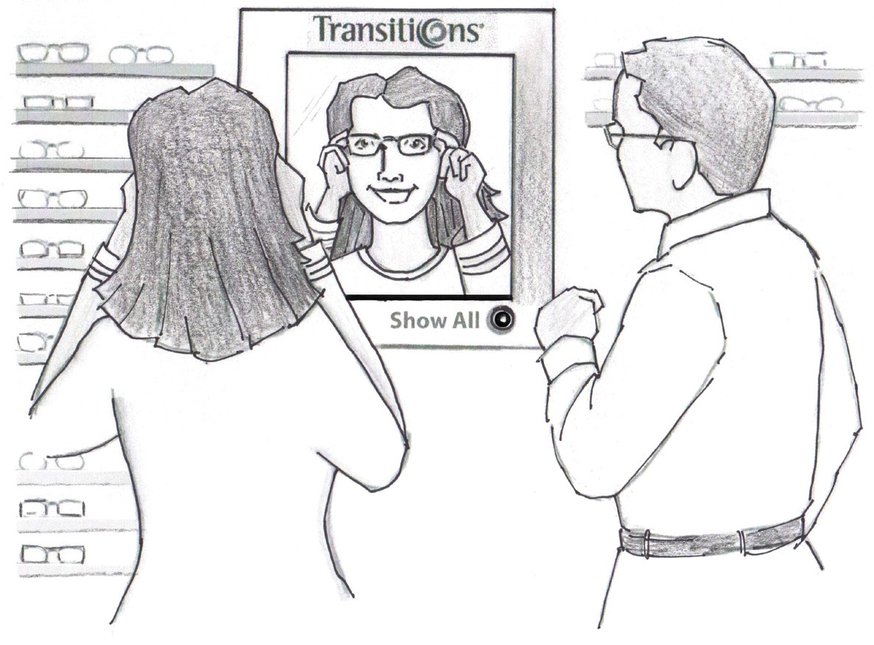
Renee Himel, VP of marketing and customer experience at Transitions Optical, and her team could see that their lenses had to be experienced to be understood. They just couldn’t yet see how to make a store work.
If you’ve said something like that in a leadership meeting and watched it go nowhere, you’re in the right place. The problem usually isn’t the business. The operation runs fine. It is that nobody inside it is free to invent the next version while running this one.
Sitting on the hunch has a price. The same move costs more a year from now, the rest of the business has less time to adapt around it, and the customers can go to a competitor who moved first.
A recent example
ShineWell Health, 2025: a hunch in the founder’s head, an investable plan in eight weeks.
The hunchThe founder, a three-time cancer survivor, could see a business in advising people on the non-medical side of a cancer diagnosis: the logistics, the decisions, the conversations nobody prepares you for. Nothing was on paper yet.
What we didDesigned the arc of the customer’s journey first, then mapped the services onto it. In eight weeks: core messaging, fifteen competitors compared, five personas, a tiered pricing model, and the story tying it all together.
What they hadA founder’s brief their first hires could run on from day one, and something people could poke holes in instead of shutting it down. Not every idea starts big. The method is the same.
“He brought leading-edge tools, including AI, to help us get to the crux of the matter faster.”— Founder, ShineWell Health Source ↗
Why this works
Leaders in this spot don’t need another report. They need the move made visible.
Another opinion won’t move it. The move has to be made visible, the way architects build a model before anyone pours concrete, so the team can walk through it and react to something real. Once people can see the move, resistance turns into improvement, and the arguing finally gets productive. That’s the work we do, and there’s a cheap, honest way to test us at the bottom of this page.
What we do
We build a working prototype of your future, so you can test the move before you fund it.
We do the research, then render your future as things people can react to. Your team walks through it, argues with it, improves it, and starts to own it. By the end, your leaders can each say where the company is going in their own words.
It moves fast, partly because we put AI to work on the research and the drafts, while the judgment stays human. Inside the first 30 days, real work lands in your hands. The short list is just below.
Storyboard frame from the Transitions Optical engagement · Storyminers
The first 30 daysReal example: iPay’s one-page statement of what the business is for, annotated in a working session.
Day 1. The first working session. The first drafts arrive the next morning; same-day drafts are coming. Days 2–30. Those drafts become the six things below, argued over and rewritten with your team. Day 31. They stop being drafts. That part is next.
That is the usual shape, not a promise. Every engagement is priced and paced by what it actually needs.
What the new business is foron one page: the sentence everything else steers by.
Options for the strategy itselfreal choices with trade-offs, not one big bet.
The customer experience, outlinedwhat buying from the new business will feel like.
Who’s responsible for whata simple map, so execution has owners before it has momentum.
How the brand should feelwritten down, usable by anyone who touches it.
Every working session, summarizeddecisions and reasoning, captured while they’re fresh.
The first drafts arrive the morning after the first working session; same-day drafts are coming. All of it is for the new idea, business, service, or brand that’s forming, not a report about the one you already run.
What comes next
Day 31 and after: turning the drafts into the real thing.
After the first drafts, we work the future into the business itself: the tools, projects, and programs it takes to reach the hunch. For iPay, that meant agreeing on a customer-first statement of what the company was for, co-writing the operating principles that let decisions get made on the front lines instead of running everything up the flagpole, and mapping who owes what to whom. Decisions that used to wait for a manager got made on the front line.
For Transitions, it meant a retail experience that existed nowhere in the industry, with every service placed on the floor plan, fixtures designed, and demos running, that leadership could walk through and improve before a dollar went into construction or leasing. Their optical partners finally had a way to show instead of tell.
Proof
Three companies that backed a hunch and went first.
McDonald'sDesigned in 1999 · standard by the 2020s.
McDonald'sThe 1999 brief was lunchtime throughput: 25% more cars through the drive-thru. Mike led the team (then at IBM) that came back with a bigger future, where the restaurant knows your order before the car arrives. They made it concrete: storyboards of the customer experience, capacity math, financial models, even job descriptions for jobs that didn’t exist yet. Twenty years on, the drive-thru works remarkably like that design: about 95% of U.S. locations have one, and it brings in well over half of all sales.
Designed in 1999 · standard by the 2020s. Source ↗
Transitions OpticalWalked before built · expected to add up to $500M a year.
Transitions OpticalEveryone, including its own leadership, saw a wholesale lens company. Mike’s team designed a store that existed nowhere in the industry, where customers could try the lenses before paying for glasses. Leadership walked through the working prototype, demos running, before a dollar went into construction. They jumped in fully, and a wholesale supplier now had a retail business it could show. The Store of the Future was expected to add up to $500 million a year in revenue over the decade that followed.
Prototype walked before a dollar of construction · expected to add up to $500M a year in revenue. Source ↗
iPay TechnologiesiPay’s co-founder could see the numbers doubling year over year. What worried him was whether the people could keep up. Mike started with the employees: diagramming how the company actually ran, designing the future employee and customer experience down to key moments and scripts, then coaching the executives through becoming it. Subscribers grew from one million to 1.8 million, and revenue from $13M to $58M.
This work goes back 30 years, 24 of them as Storyminers, and adds up to $3.2 billion in documented client value Source ↗. We count what the client got: revenue, savings, costs avoided. Never a sale price.
“[Storyminers] developed experiences designed to turn heads, and the underlying capabilities our businesses needed to deliver them. I’d love to work with them again.”— Renee Himel, VP of Marketing and Customer Experience, Transitions Optical Source ↗
The first two do the work. The other three help it land: with your audience, your board, one leader at a time. Every format is Mike, hands-on, with specialists joining where the work needs them:
Leadership Alignment Workshopone to three half-day sessions over one to two weeks. Your leaders leave pointed in one direction, each able to say it in their own words. Typically from $25,000 for the whole leadership team.
Strategic Advisoryongoing. A standing advisor for the decisions that are hard to walk back: a session every month, a call when something big is forming, and the written work done between. From $9,000 a month, for the organization’s leader.
Speakingone hour on your stage. A whole room (your company, your board, your industry) gets the same picture of what’s coming. Keynotes from $15,000, all-inclusive.
Independent Directora standing board seat. A director focused on what’s ahead, not just what’s reported. The company usually names its rate first.
Coachingtwice a month, one-on-one, until you don’t need it. For the leader growing into a job bigger than any they’ve run; with homework, for both of us, in between. $4,500 a month for a division president, a vice president, or a director; $9,000 a month for the organization’s leader (the CEO or president).
Not sure which fits? Bring the situation, not a category. That’s what a Chemistry Check is for: a free hour where we work on it together.
Work is priced by scope, not by the hour. The figures above are where engagements usually start; you’ll know the exact cost before you commit to anything.
When we’re not the right choice.
We turn work down for concrete reasons. The usual four:
You want incremental improvement: this year’s model, a little better, with everything else staying the same. That’s good work; it isn’t ours.
You need technical help (backend infrastructure, programming, the tech stack) more than help with the next move.
You’re eager for the conversation about change, but not yet ready to put in the work behind it.
You’re full of ideas, but from the first conversations the two of us struggle to get in sync. It happens; when it does, we say so early and part as friends.
The decision you are weighing is not a small one. So the numbers, the methods, the sources, and the
times we were wrong are all written out, where you can judge them.
If you would rather not read all of it, don’t. Paste any page into your AI and ask it the hard
questions. Would this work for a company our size? What would Mike need from us to make
it work? What combination of services is best for our situation?
A short site cannot answer those. This one can, so you will know whether we fit before anyone
picks up the phone.
Change the Framea Storyminers field guide
The field guide
The frame is Storyminers’ cornerstone idea. Every company runs on a picture of what business it’s in. That picture is the frame, and it decides what leaders can see and act on, and what they can’t. Our short field guide shows how frames form, how to spot yours, and how changing it lines people up behind a new direction.
It’s free and complete on its own — useful even if we never meet.
The download starts right away. If you’d like it by email too, there’s a one-line option on the next page.
The next step
Book a free hour with Mike — no pitch.
A working conversation about the future you’re trying to create, and what’s keeping it from moving. Around here it’s called a Chemistry Check: a fit test that runs in both directions.
A conversa pode ser em português.La conversación puede ser en español.